
To begin with, let me break down the word autoethnography” into it’s component parts, to get a better understanding of it.
- Auto = self
- ethno =culture
- graphy = scientific study of
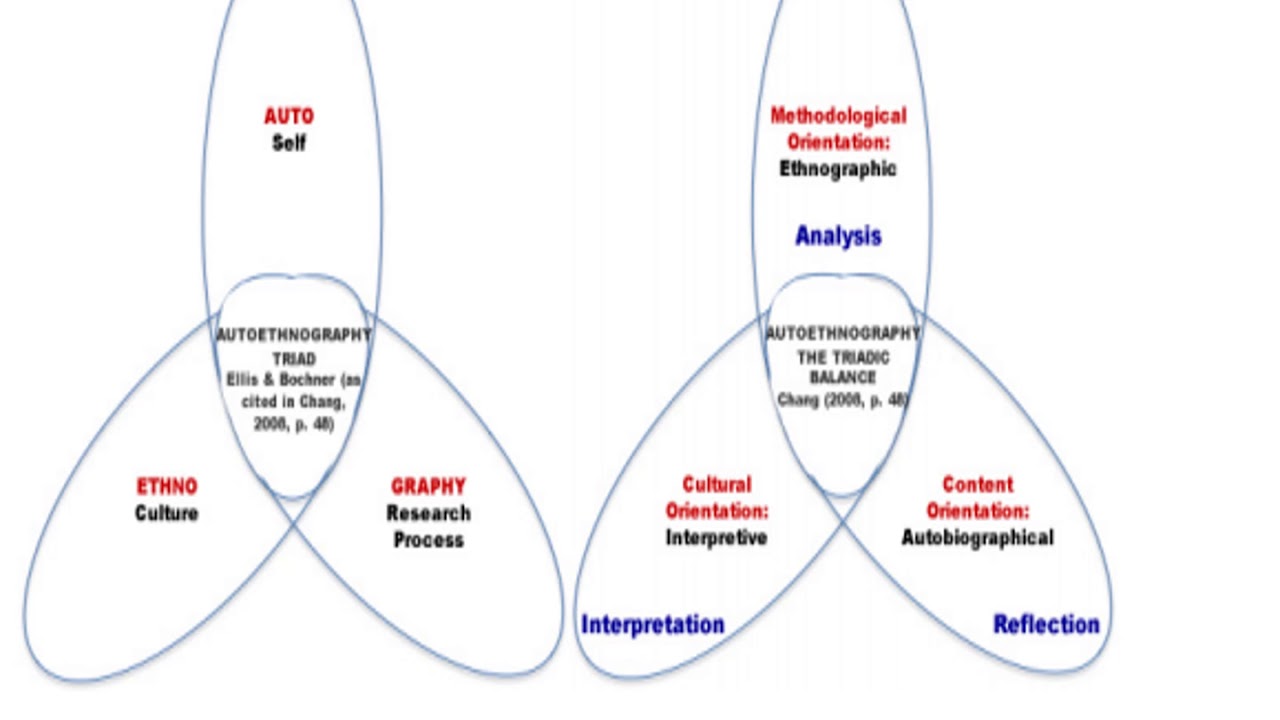
Autoethnography could mean different things to different people, Ellis and Bochner (2000) define Autoethnography as “autobiographies that self-consciously explore the interplay of the introspective, personally engaged self with cultural descriptions mediated through language, history, and ethnographic explanation” (p.742) Although their definition appears to focus more on autobiographical description than ethnographic analysis and interpretation, they certainly acknowledge the importance of “ethnographic explanation”. This “explanation” aspect makes Autoethnography transcend autobiography by “connecting the personal to the culture” (p.739).
Autoethnography is an approach to research and writing that seeks to describe and systematically analyze personal experience to understand cultural experience. This approach challenges canonical ways of doing research and representing others and treats research as a political, socially-just and socially-conscious act. A researcher uses tenets of autobiography and ethnography to do and write autoethnography. Thus, as a method, autoethnography is both process and product.
Autoethnography aims to teach outsiders about one’s culture through both personal and empirical research. It also helps people within their culture better understand themselves. In “Arts of the Contact Zone,” Mary Louise Pratt defines an autoethnographic text as a text in which people undertake to describe themselves in ways that engage with representations others have made of them” (Pratt).
Autoethnography usually goes up to people outside their culture who may or may not have a positive or accurate understanding of your culture. In other words, autoethnographies “speak back” to outsiders who have misunderstood or misrepresented your culture.
Autoethnography is becoming a particularly useful and powerful tool for researchers and practitioners who deal with human relations in multicultural settings, such as educators, social workers, medical professional and counsellors. The benefits of Autoethnography lies in three areas. First, it offers a research method friendly to researchers and readers. Second, it enhances cultural understanding of self and others and last but not the least, it has the potential to transform self and others to motivate them to work toward cross-cultural coalition building.
Methodologically speaking, Autoethnography is a researcher- friendly. This inquiry method allows researchers easy access to the primary data source from the beginning because the source is the researchers themselves. Auto ethnographers are privileged with a holistic and intimate perspective on their “familiar data”. This initial familiarity gives auto ethnographers an edge over other researchers in data collection and in-depth data analysis.
Moreover, Autoethnography is an excellent tool through which researchers come to understand themselves and others. Self- reflection and self-examination are the keys to self-understanding (Florio-Ruane,2001; Nieto,2003). Kenneth (1999) concurs with other advocates of self-reflection, saying that “writing cultural Autoethnography allows students to reflect on the forces that have shaped their character and informed their senses of self” (p.231). the “forces” that shape people’s sense of self include nationality, religion, gender, education, ethnicity, socioeconomic class, and geography. Understanding “the forces” also helps them examine their preconceptions and feelings about others, whether they are “others of similarity” “others of differences” or even “others of opposition” (Chang,2005).
RERERENCE:
- Ellis, C., Adams, T. E., & Bochner, A. P. (2011, January 10). Autoethnography: An Overview. Retrieved February 6, 2020, from http://www.qualitative-research.net/index.php/fqs/article/view/1589/3095
- Maguire, M. H. (2006, March 16). Review Essay: Autoethnography: Answerability/Responsibility in Authoring Self and Others in the Social Sciences/Humanities. Retrieved February 6, 2020, from http://www.qualitative-research.net/index.php/fqs/article/view/106/221
- You need to have JavaScript enabled in order to access this site. (2018, March 20). Retrieved February 6, 2020, from https://wcc.instructure.com/courses/1556817/assignments/11362740

 Laxmi’s Blog
Reblogged this on DIGC330 Digital Asia.
LikeLike