Posted in DIGC330

Using the Auto-ethnographic methodology to analyse your narrated experience detailed in Blog Post 3 (Korean Drama Fever)

In my previous blog post, I talked about my experience of Korean drama that I watch from since I was 12 years old until now. I want to know more about “Korean Drama” because it has become very famous all over the an and I want to explore more about the historical background of it, try to analysis the deep meaning of the setting of the story and based on my interviews with my fellow Korean drama lovers I will try to figure out how people regard or understand it.

Refereeing back to Ellis, Adams and Bochner, I am going to use the process of recollection of memories, images and feelings to write my autoethnography. According to Ellis et al, they are “remembered moments perceived to have significantly impacted the trajectory of a person’s life. (ELLIS et al 2011, pp2/13) What epiphany that people have got after the experience is the most important things affecting their lives.

I have talked a little bit about my personal experience regarding the Korean drama fever which probably doesn’t give the reaction and the interaction of the other people who love and watch the Korean Dramas. So to get a better understanding of that in this blog I will be focusing more on 

  1.     How/Where Korean drama lovers get access to watch it?
  2.     Do Korean dramas affect their life? If so, how?

Although they have experienced the same things everyone will get their own epiphany.

To get a better response to these questions. I will be interviewing some of my fellow Korean Drama lovers and get to know how/where do they get access to watch Korean Dramas from. Also their behaviour like do they still buy the DVDs, online or any other platform or means. I will also be asking about their experience/ feelings after finishing the drama. Although we experience the same things as watching Korean Drama, in this case, it’s not guaranteed that everyone will feel the same way because we all have our epiphany. 

I will also be talking about my South Korea trip and how I saw my Korean fantasy come to life. I bet a lot my fellow Korean Drama lover can agree that while watching the drama we indulge ourselves so much into it that we once in a while have thought of going to South Korea and experiencing that Korean lifestyle like be it just going out for the Korean fried chicken with a beer or just strolling through some night markets and probably grabbing some Korean classic street foods such as tteokbokki, gimbap and so on. 

Trip to “Gyeonghuigung” Palace in South Korea

And this is what I exactly did when I went to South Korea a few years ago (2016). It was one of the best trips of my life because I got to experience first-hand all the things that I had been watching in Korean Dramas for years and I loved it. We went to sight-seeing some historical building like “Gyeonghuigung” which was served as the secondary palace for the king meaning the palace was where the king moved to in times of emergency. and we were also told that some of the historical Korean Dramas were shot in this palace. I connected to this visit because it reminded me a lot about my own country; Nepal because the interior design and the palace structure were kinda similar to the Nepalese palace which it made me think of Nepal and the Royal family.  

What I noticed during my visit to “Gyeonghuigung” palace was that the most of the people visiting were foreigners and they seemed to be aged between 10s the to late 30s and everyone seemed to be busy taking pictures and some of them were even wearing the traditional Korean attire and strolling around to get the full experience. There were very few people who looked in detail and stuff to look at the palace and appreciate the amount of work that went to build that palace. 

While thinking back to that moment, I think it’s the rapid growth of our technology that we are so attached to our electronic devices and always want to capture everything that we see rather than just live in the moment and feel the atmosphere and appreciate the work and understand the history behind it. I am not saying that its wrong to document or film stuff but if you think about it we don’t seem to enjoy the moment and take it in and just document and pass through it like we’re just there to show film it and maybe put it on our social platforms to show off.?

Its an interesting phenomenon to see people latch on to their electronic gadgets be it on public, during a meal or even during a toilet break. Gadgets cover every facet of our life and have resulted in an overbearing dependence on them. In today’s era Technology is a good investment in our life but we shouldn’t be too focused on it and forget the life without Technology.

Reference

Ellis, C., Adams, T. E., & Bochner, A. P. (2011, January). Autoethnography: An Overview. Retrieved March 5, 2020, from http://www.qualitative-research.net/index.php/fqs/article/view/1589/3095

Posted in DIGC330

Independent Digital Asia Autoethnography- Korean-Drama

My personal Korean Drama craze goes back to few years ago when I was 12 years old and my best friend introduced me to KDramas. She was going on and on about this “Boys over flowers” drama that she had been watching and wouldn’t blabbing about it. So I thought of giving it a go and one day I went to buy “Boys over flowers” DVD since the WiFi wasn’t available at that time. The storyline was one of the usual rich guy – poor girl love stories. Although I didn’t like main character, Lee Min Ho’s character very much I still enjoyed the drama and finished all 16 episodes. And then watched a second KDrama, and a third, and that’s how the madness started. 

I think I’m greatly influenced by KDrama because I have actually incorporated some of the Korean lifestyle habits such as eating kimchi with my meals, my love the Korean spicy ramen is definitely undeniable. I also loved my visit to South Korea which allowed me to experience some first-hand culture experience and customs. 

Where in today’s world some of the best American shows avoid sentimentality with the efficiency of a professional slaughterhouse worker. Unsympathetic characters offer us intellectual pleasures, but not a lot of laughs or smiles. Korean shows are emotional. They can tell smart stories too, but they really want to touch your heart. K-drama wants you to cry so hard that you’ll have to wring out your handkerchief. 

Korean dramas are lees sexual and violent than the other products from Hollywood which widens the range of group of its viewers and makes the drama watching experience comfortable, especially for the conservative parts of the world like the Middle East, where TV watching is a family affair. People even think feel that values portrayed in these dramas may be can inspire the lifestyle in their respective countries. 

The best K-dramas offer a few characters we might want to cheer on to success. Just as the best American shows require us to watch the darkest side of humanity by throwing the spotlight on violent crimes and murder, a good Korean show sometimes requires us to watch the corniest side of humanity. Romantic couples hold hands in public. Friends embrace. Characters sacrifice everything for the people they love, sometimes for really silly reasons. I can still appreciate a smart American drama about anti-heroes. But I also like the change of pace I get from K-dramas. 

The writers of K-dramas re-use story elements we’ve seen before, and find ways to make them look new. I’ve learned things from them about genre, tone, character and how to structure a long story with multiple characters and plotlines. Not coincidentally, K-dramas also draw on the finest story formulas of the old classics. It’s all here: missing children, poor orphans, mysterious benefactors, self-sacrifice, sudden changes in fortune and legal battles to rival. 

These stories don’t revolve around the question, “What will happen?” Depending on the formula, we can often guess what will happen. (Spoiler alert: if it’s a romantic comedy, the guy will probably get the girl.) Instead, the stories are propelled by the question, “How will it happen?” Boy meets girl is the starting point for the majority of K-dramas, but how will they meet? I’m fascinated with how this freshness is possible. What makes audiences suspend disbelief and approach an old story like it’s new?

Watching a Korean show is an expedition to another country, where I don’t know anyone and no one knows me. I don’t speak the language. (Though I’ve started studying it in fits and starts.) I don’t know what behaviour is normal and what’s unusual. The food looks weird and they eat rice for breakfast.

But after watching a lot of South Korean television, the culture looks increasingly homey. Though watching television isn’t much of an immersion, it still gives me a faint experience of a distant place. Those living rooms where everyone sits on the floor around a low table look more comfortable to me now.

And the surface differences in style between American and Korean television are large. Though they have familiar story elements, Korean shows often have unfamiliar aesthetics. From the perspective of a strict realist, a K-drama is overwrought. It’s melodrama.

On the most basic level, K-dramas are escapist entertainment. K-drama hits the spot, or at least for me it sure does. 

References:

Posted in DIGC330

Autoethnography overview

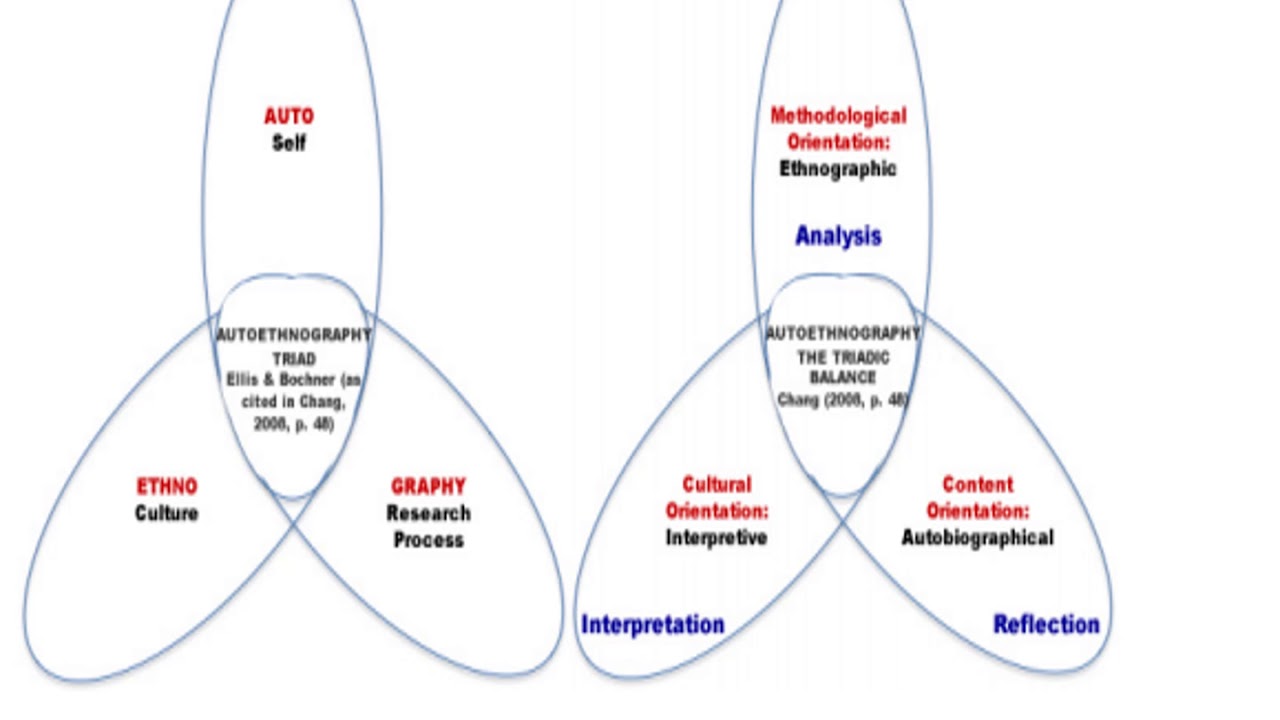
To begin with, let me break down the word autoethnography” into it’s component parts, to get a better understanding of it. 

  • Auto = self
  • ethno =culture
  • graphy = scientific study of
Image result for autoethnography diagram

Autoethnography could mean different things to different people, Ellis and Bochner (2000) define Autoethnography as “autobiographies that self-consciously explore the interplay of the introspective, personally engaged self with cultural descriptions mediated through language, history, and ethnographic explanation” (p.742) Although their definition appears to focus more on autobiographical description than ethnographic analysis and interpretation, they certainly acknowledge the importance of “ethnographic explanation”. This “explanation” aspect makes Autoethnography transcend autobiography by “connecting the personal to the culture”  (p.739). 

Autoethnography is an approach to research and writing that seeks to describe and systematically analyze personal experience to understand cultural experience. This approach challenges canonical ways of doing research and representing others and treats research as a political, socially-just and socially-conscious act. A researcher uses tenets of autobiography and ethnography to do and write autoethnography. Thus, as a method, autoethnography is both process and product. 

Autoethnography aims to teach outsiders about one’s culture through both personal and empirical research. It also helps people within their culture better understand themselves. In “Arts of the Contact Zone,” Mary Louise Pratt defines an autoethnographic text as a text in which people undertake to describe themselves in ways that engage with representations others have made of them” (Pratt).

Autoethnography usually goes up to people outside their culture who may or may not have a positive or accurate understanding of your culture. In other words, autoethnographies “speak back” to outsiders who have misunderstood or misrepresented your culture.

Autoethnography is becoming a particularly useful and powerful tool for researchers and practitioners who deal with human relations in multicultural settings, such as educators, social workers, medical professional and counsellors. The benefits of  Autoethnography lies in three areas. First, it offers a research method friendly to researchers and readers. Second, it enhances cultural understanding of self and others and last but not the least, it has the potential to transform self and others to motivate them to work toward cross-cultural coalition building. 

Methodologically speaking, Autoethnography is a researcher- friendly. This inquiry method allows researchers easy access to the primary data source from the beginning because the source is the researchers themselves. Auto ethnographers are privileged with a holistic and intimate perspective on their “familiar data”. This initial familiarity gives auto ethnographers an edge over other researchers in data collection and in-depth data analysis. 

Moreover, Autoethnography is an excellent tool through which researchers come to understand themselves and others. Self- reflection and self-examination are the keys to self-understanding (Florio-Ruane,2001; Nieto,2003). Kenneth (1999) concurs with other advocates of self-reflection, saying that “writing cultural Autoethnography allows students to reflect on the forces that have shaped their character and informed their senses of self” (p.231). the “forces” that shape people’s sense of self include nationality, religion, gender, education, ethnicity, socioeconomic class, and geography. Understanding “the forces” also helps them examine their preconceptions and feelings about others, whether they are “others of similarity” “others of differences” or even “others of opposition” (Chang,2005).

RERERENCE:

Posted in DIGC330

Gojira the Japanese Original

Godzilla (1954)
1954 movie poster

My first exposure to Godzilla came from watching it in class shown by one of our lecturers. We were shown the original Japanese Godzilla “Gojira”1954 directed by Ishiro Honda. My first reaction of the movie was that it had some heavy awkward dubbing and the Godzilla; the man in a rubber suit walking around crushing model Japan cities looked funny. But after doing some research I came to appreciate the movie as I learnt that the amount of work that went into crafting this pretty impressive. It was the most expensive film ever produced by a Japanese studio and ever since Godzilla has been featured in comic books, video, games, commercials, and cartoons. 

Godzilla was a clear embodiment of Japanese fears about nuclear weapons in the wake of the atomic bombings of Hiroshima and Nagasaki. It maintains a similar balance but the only improbable nature of the central metaphor (substituting a mutated dinosaur for the nuclear weapon rather than simply letting the bomb be a bomb) and an oft-side-lined love story shift Gojira toward pure fiction. Deals with some intense socio-political conversation under the mask of a creature feature. 

A scene from Godzilla (1954), directed by Honda Ishirō.

In the movie, Godzilla can be seen more than just an allegory for the atomic bomb, but a living one. It sort of behaves just like a nuclear weapon: cold, uncaring, designed specifically to kill most effectively, attacks without any warning, leaves a huge cloud of destruction and is unstoppable.

The movie also tackles themes of the public’s right to knowledge or censorship, truth at the cost of chaos, nature taking revenge and the intellectual approach of studying the creature from a radiological perspective versus quickly eradicating a dangerous new species, and the consequences of the inevitable weaponization of any private invention powerful enough to stop the menace. Its seems like a psychological study about how a country reacts to crises. 

What makes Godzilla all the more interesting, and somewhat scary, is that the people created him. It was through their continued use of atomic bombs and a failure to understand the true power that they got Godzilla. They had nobody to blame themselves. 

Some people even empathize with that struggle of the monster; Godzilla surviving against the odds. This movie was a cathartic romp that touched the hearts of its audiences. Even to this day, in the age of realistic special effects; “Gojira” remains the gold standard to which all creature features are compared.

YETI- Nepalese mythical creature

THE YETI, ILLUSTRATION FROM “MONSTERS AND MYTHIC BEASTS” 1975 

While watching Godzilla it reminded me of a creature from Nepal, which is called YETI, an “Abominable Snowman”, who looks like an ape, is taller than an average human and is believed to live in the Himalayas, Siberia, Central and East Asia. According to a Sherpa legend, they are the children of a Tibetan girl and a large ape which could be a reason why they are believed to exist between the human and animal worlds. 

The Hindus relate the yeti to the Monkey God, Hanuman, who is also depicted as half-human and half-monkey. They also consider the yeti to be disciples of Shiva and are thought to be spirits from the Sun. 

Yetis are apelike creatures of myth

Similar to other famous cryptids such as the Bigfoot and the Chupacabra, the yeti has been a subject of constant scrutiny. We know about the creature’s cultural and religious significance but what exactly is it anyway? The celebrated Italian mountaineer Reinhold Messner, the first man to climb Everest without oxygen, believes the yeti and chemo, an elusive Himalayan bear that locals are terrified of, are the same. 

In his book “My Quest For The Yeti” he believes that chemo turns into a yeti down in the valleys where people are unfamiliar with it. And that the notion of the yeti being some kind of monster spread from the Sherpa territories and ignited the imagination of people across the world.

Why do we believe in myth?

We have tons of such fantastical tales may be due to some basic cultural-based need as humans have a fascination with the divide between our species and animals. But whatever it may be, Messner puts it right when he says that the “yeti belongs to anyone who has heard of it and no one wants to give up the picture they have in their head. The yeti is thick-skinned, he has no idea that half the world is thinking about him.”

But all in all, the tales of monsters and mythical characters can sometimes make us feel weak and helpless, or at times make us sympathetic to their tragic story and even cheer us up which makes defining a monster a difficult task. As we see from the movies now, a creature/ monster can be portrayed as both good and bad like in the movies, twilight, Dracula. Personally, I love reading and watching stories about these mythical creatures as it ignites excitement and curiosity to know more about the culture. 

References: